


Is consumption really cooling, or is it simply changing?
This is a question on many people’s minds today. On the one hand, growth in total retail sales has slowed, price wars continue to intensify, and the consumer sector appears increasingly subdued. On the other hand, a number of leading consumer companies continue to grow at more than 30% annually, with some even expanding against the cycle during industry downturns.
Perhaps the answer is this: growth is still there, but its source has changed.
Recently, Victor Zhang, Founding Partner of GenBridge Capital, shared his observations and perspectives on China’s consumer market at CICC’s 2026 Autumn Investment Strategy Conference in Hong Kong. At the conference, he put forward a core thesis: China’s consumer market is shifting from supply-driven growth to demand-driven growth.
In his speech, Zhang used the classic “value stick” framework to examine price competition and the sustainability of business operations in the sector. He also shared his views on the short-term cycle, three long-term growth drivers—domestic consolidation, global expansion, and AI—as well as his understanding of the fundamental nature of consumption.
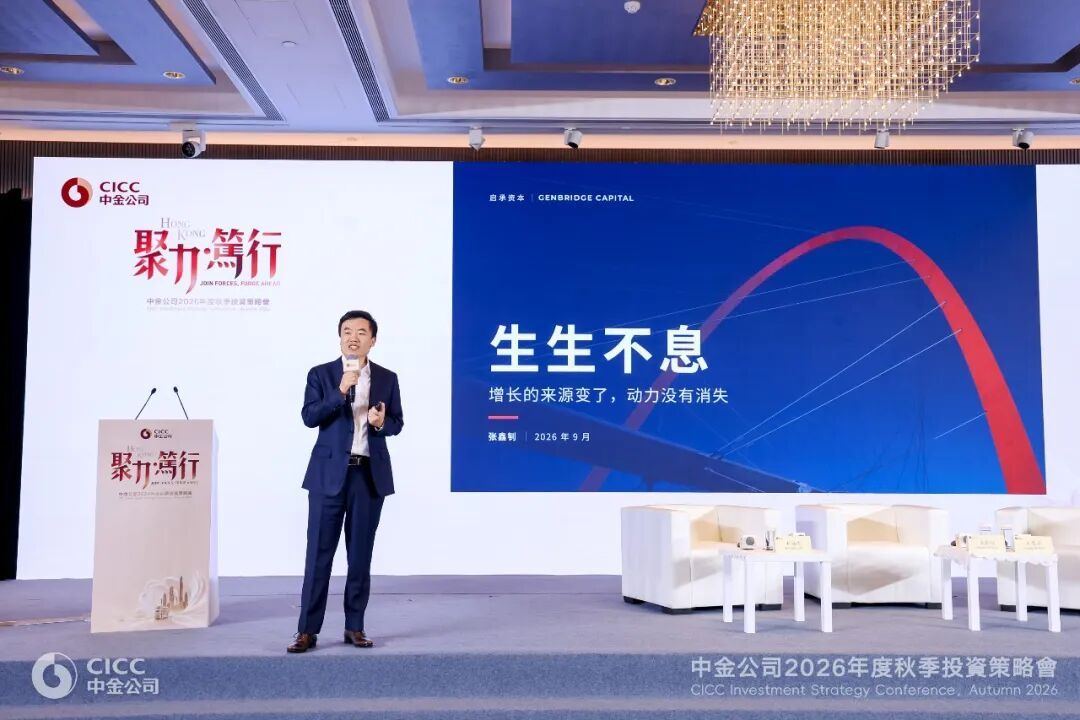
Below is an edited transcript of Zhang’s speech.
The source of consumer growth has changed
It is a pleasure to have this opportunity to join CICC's event and talk with you about consumption.
I previously worked at CICC, which was where I entered this industry. I later joined JD.com’s strategic investment team. These two experiences gave me perspectives from both finance and industry. GenBridge Capital was born at the intersection of these two perspectives. So, from Day 1, we have held one conviction: we focus exclusively on consumer investments, and we look at consumption through the lens of entrepreneurs and industry.
There is one topic everyone is talking about today: consumption is cold. How cold is it? Even leading consumer companies have stopped speaking out. In the short term, everyone can feel the chill.
However, as growth equity investors, our typical holding period is five to seven years, and we look for opportunities that can deliver five- to tenfold returns over periods of five years or more. We pay less attention to short-term noise and focus more on the long-term drivers.
So, today I mainly want to discuss two things:
First, the real picture of the consumer companies we invest in and the market conditions they are experiencing;
Second, our broader thoughts on China’s consumer market and where the long-term opportunities lie.
This year marks GenBridge’s tenth anniversary. Over the past decade, we have invested in more than 20 companies, which together generate over RMB 100 billion in revenue and operate more than 50,000 stores. Although the market is cold, based on the actual performance of these companies, both revenue and profit have maintained roughly 30% annual compound growth. By global standards, that qualifies as high growth.
We believe consumer growth is still there, but its source has changed.
We call the growth of the past “elevator growth”—the entire industry was growing, with total retail sales increasing by 10%. As long as you stepped onto the elevator, achieving double-digit growth was not difficult. Companies were more like parallel players, and competition was relatively limited.
By contrast, today, total retail sales growth has fallen to just over 3%, while companies are still expected to maintain 30% growth. The difficulty has increased exponentially.
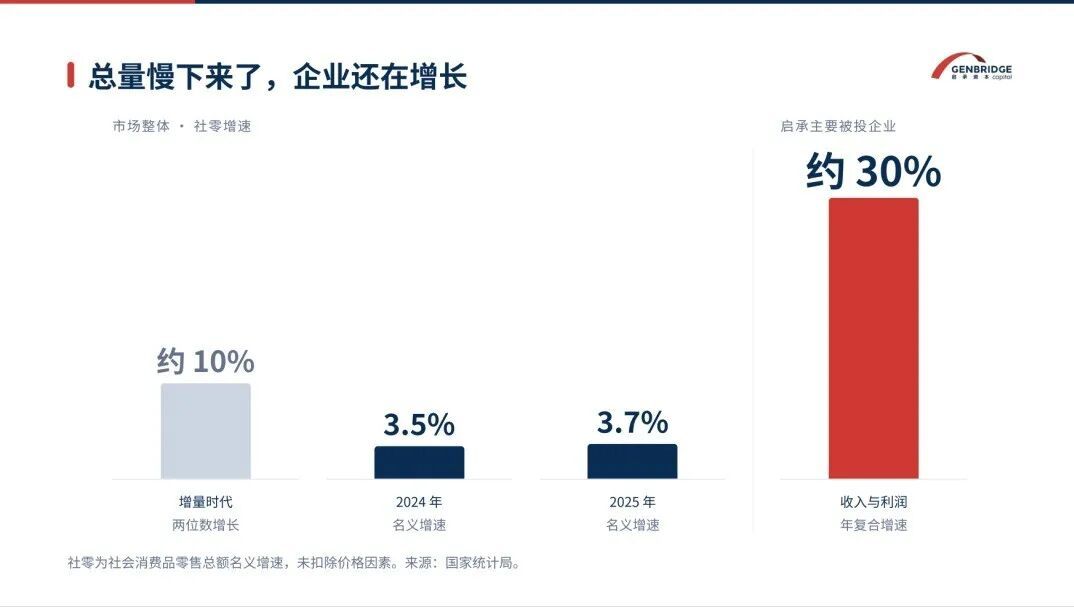
So, where exactly does the growth of these leading companies, which continue to grow at 30%, come from?
When the overall market shrinks, it essentially means that consumers’ purchasing power is constrained. To grow in this environment, you have to win other companies’ consumers and take their share. Growth has therefore shifted from being supply-driven to being demand-driven—
Whoever can rebuild the value chain around consumers and create value in new ways can gain market share—either by replacing others or by creating a competitive structure that works in their favor. That is where profits are coming from today.
For companies, it is now a matter of moving forward or falling behind. If you do not take share from others, others may take yours. That is why the requirements for a company’s competitive moat have become much higher.
Does this feel somewhat familiar? The concept of a competitive moat—the very idea that has long been emphasized in developed Western markets, and associated with Buffett’s investment philosophy—is suddenly being widely discussed in China, right here and right now. It is not because people’s thinking has changed, but because the underlying logic of the market has changed dramatically.
One end understands consumers, the other reorganizes the supply chain
When it comes to demand-driven growth and creating value for consumers, everyone talks about experience and efficiency. But today, I want to borrow a framework and take these two concepts one level deeper.
Behind experience is the ability to create consumers’ willingness to pay (Willingness to Pay, WTP).
Behind efficiency is the ability to improve suppliers’ willingness to sell (Willingness to Sell, WTS).
One end understands consumers, the other reorganizes the supply chain. This is what we call the “value stick”: at the top is what consumers are willing to pay (WTP), and at the bottom is what suppliers are willing to sell for (WTS). Everything in between is value.
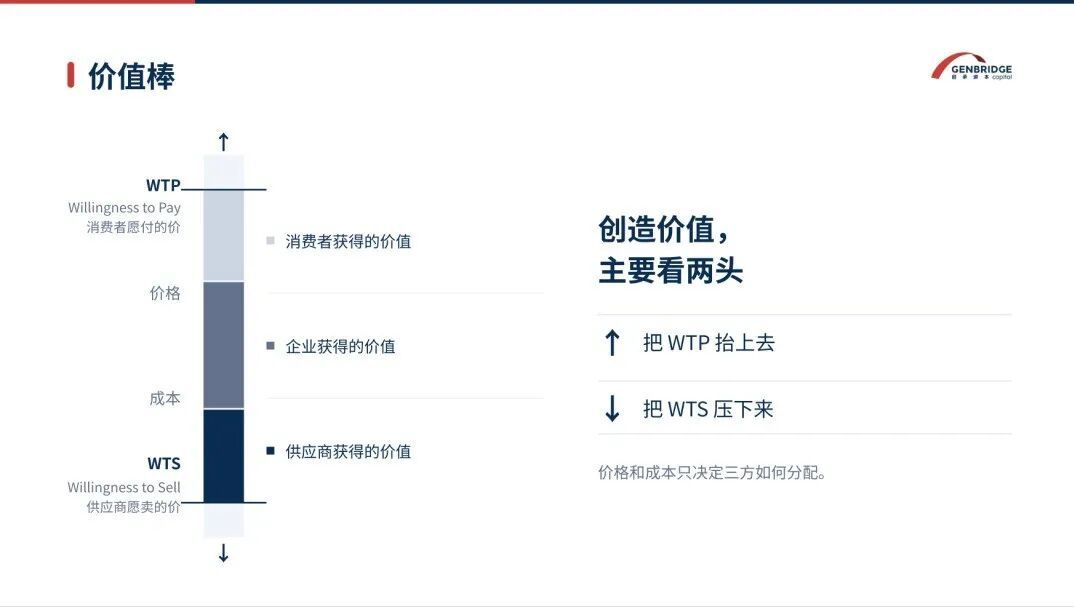
The way we have traditionally thought about this is to redistribute that value among the three stakeholders: consumers, companies, and suppliers.
But the real long-term power does not come from redistribution. It comes from making the entire value stick longer: raising WTP and lowering WTS.
Let’s look at two common misconceptions in the industry.
Misconception One: Is competing on price the only way forward?
The price war has become almost unrestrained, and everyone is suffering. Is competing on price really the only option?
Let me give an example that everyone is familiar with—Sam’s Club. Sam’s charges a membership fee and has a high average basket size, yet consumers still feel that its prices are very low. Not only that, suppliers are also highly willing to supply Sam’s, because it is often one of their most profitable channels.
That is because Sam’s creates a tremendous amount of value. For example, it works with suppliers to define products; it discusses technological upgrades and identifies where products and specifications can be made more precise; it shares data to stabilize production scheduling; and it does not switch suppliers arbitrarily. All of this makes suppliers willing to work with Sam’s at a more competitive price while maintaining a given level of quality.
What Sam’s does is lengthen the value stick, and then redistribute the value once again.
So efficiency does not mean competing on price. Efficiency means reorganizing the industrial chain. At its core, organizing the industrial chain means matching consumer demand more precisely.
Let me give another example—Yeswood, one of our portfolio companies.
Yeswood is the company I have been asked about most frequently over the past year, because its performance is so counterintuitive. At a time when the real estate market is deeply depressed, a company with more than RMB 10 billion in revenue is still growing at an annual rate of 40% to 50%.
One very important point is that it is also working on both ends of the value stick.

On the WTP side—consumers’ willingness to pay. Yeswood focuses on solid wood furniture, providing consumers with a stronger sense of security. It has expanded from dozens of SKUs to 20,000 today. Furniture used to be largely non-standard in size, making the search cost very high; today, consumers can purchase everything in one place. Its stores are also closer to consumers and more densely located, making the shopping experience more convenient. All of these factors increase consumers’ willingness to pay.
On the WTS side—supplier efficiency. The supply chain for solid wood furniture remains highly traditional and still relies heavily on manual labor. Many small factories operate more like workshops, with relatively low production ceilings. Yeswood works with these factories one by one, taking up 70% to 80% of a small factory’s orders while producing only a limited number of furniture styles. This improves both the learning curve and production efficiency, while also making production scheduling more stable and equipment utilization higher.
As a result, Yeswood continues to expand its SKU range and store network, creating a positive cycle and ultimately becoming a highly successful, high-growth company.
Misconception Two: Can the excitement last?
The consumer industry has never lacked opportunities to make money, nor has it lacked companies capable of explosive growth. It is much like the fashion shows we watch every year: there are always plenty of companies that attract attention, only to disappear as quickly as they emerged.
But as a long-term investor, what matters more at this moment is whether a company can endure after the excitement fades. After going public, after a period of rapid growth, will the company still exist ten years from now?
Of course, everyone ultimately says that “brand power is important.” But brand power is an intangible concept that is difficult to measure. This is where we can once again use the value-stick framework as a checklist.
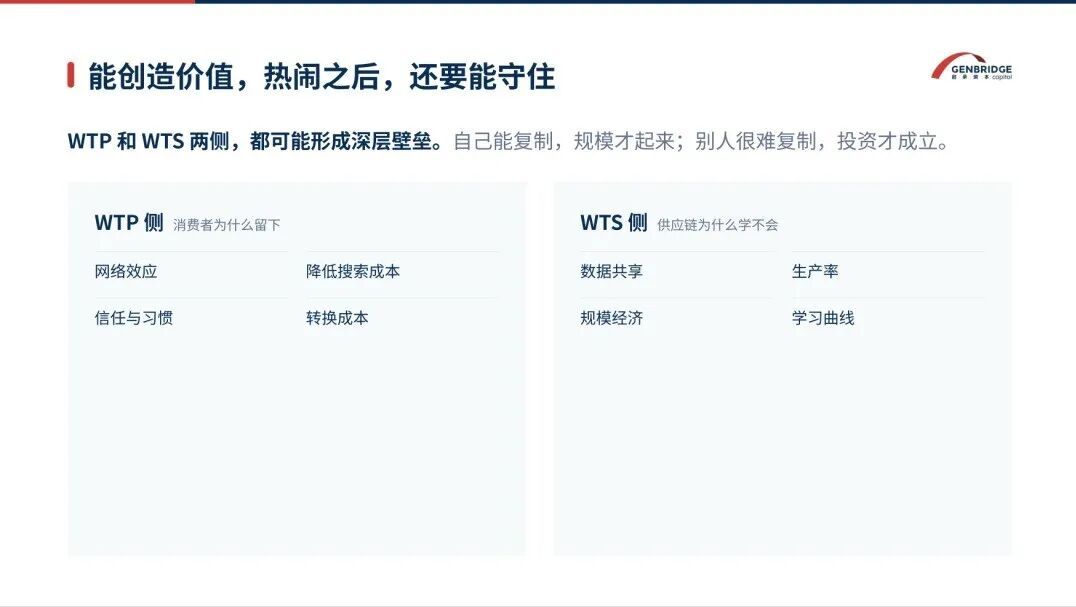
On the WTP side: Why do consumers stay? Is it because search costs have been reduced? Trust and habit? Switching costs? Or network effects?
On the WTS side: Why can’t suppliers replicate the advantage? Is it the productivity improvement brought by data sharing? Economies of scale? Or the learning curve?
We can use this checklist to ask: Will the companies we invest in today still exist ten years from now? Are these barriers truly barriers? Or is the company simply benefiting from a temporary consumer tailwind and generating a great deal of excitement?
Filtering out short-term noise and focusing on long-term judgment
I learned a new term today: “insensitivity to noise.” As long-term investors, we need to filter out short-term noise and focus on long-term opportunities.
Short-term changes are like a pendulum — moving between good and bad, constantly fluctuating. But what is the purpose of a pendulum? It helps society adjust and respond. This is the logic behind market clearing.
A colder market is not necessarily a bad thing, because it forces some people to become more rational: stop expanding unnecessary capacity, move into new industries when needed, and stop engaging in meaningless competition. This process creates long-term opportunities.
From a long-term perspective, why do I like investing in consumption? Because in modern society, consumer capitalism has become one of the fundamental social systems we have built. Within this system, most industries serve as upstream sectors of consumption. Changes across all industries eventually flow into consumption — or, in other words, consumption is the driving force behind all industries.
In 2000, China joined the WTO, which essentially meant entering the global consumer market. We became part of the upstream supply chain serving Western consumer markets and benefited from this transition. Urbanization, real estate, and mobile internet — these were the incremental growth markets of that era.
By 2020, we had moved from an incremental market (solving the transition from 0 to 1) to a stock market (solving the transition from existing to better). We believe there are three major opportunities ahead:
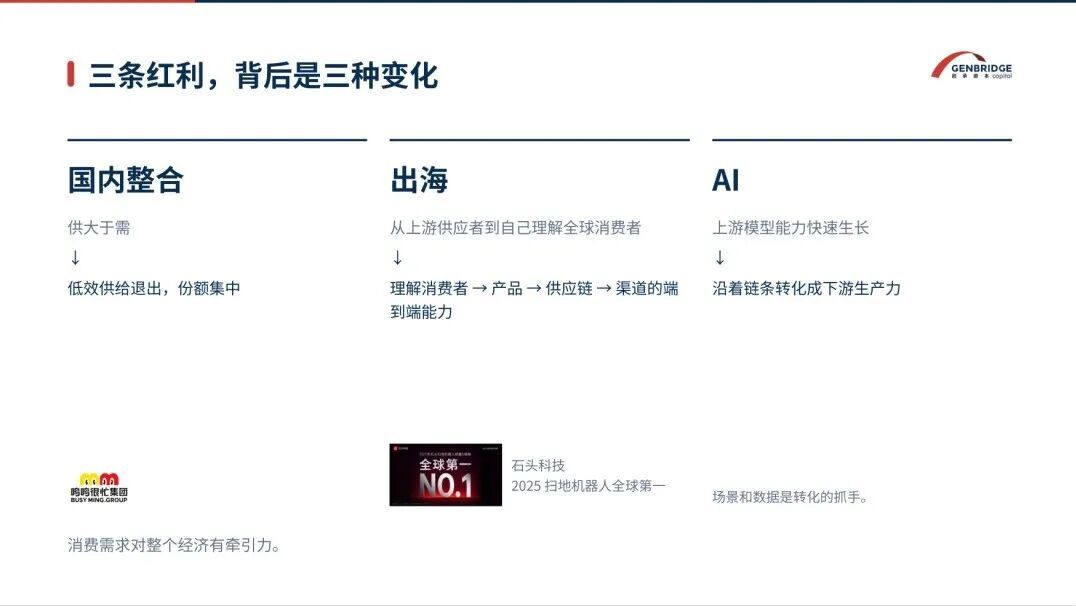
First, domestic consolidation. In the short term, supply exceeds demand, making consolidation the biggest theme. Companies such as Busy Ming Group and Wanchen are achieving a level of consolidation speed that China has never seen before, rapidly creating large-scale industries with high market concentration and the potential to build trillion-RMB-level companies.
Second, going global. Companies across industries are actively embracing overseas expansion. Bringing the capabilities and competitiveness developed through China’s intense domestic competition to global markets, combined with localized adaptation, creates opportunities to become world-class companies.
Third, AI. Most of today’s AI discussions focus on upstream areas — large language models, computing power, chips, and storage. In China, we have not yet deeply experienced AI’s impact on improving efficiency in the consumer industry, so the direct perception remains limited. But I do not think we need to rush. As the saying goes, “it may arrive late, but it will arrive.” After so much investment in computing power and infrastructure, AI will ultimately serve consumption.
In fact, we are already seeing early signs of this trend. For example, Busy Ming Group has introduced AI into store inspections. Store managers carry cameras during inspections, and regional managers can simultaneously analyze the captured content through data tools, improving overall operational efficiency.
Although this transformation may not yet be strongly felt by everyone, it is happening every single day. We remain highly optimistic about this development.
Today, we are living in an era of existing markets. Compared with the past, the next decade will be defined by market share and competitive dynamics — these will be the most critical factors.
Conclusion: An endless cycle of growth
Finally, let me step back and talk about one fundamental question — what is consumption?
Everyone has different aspirations and desires. Some people love Hermès, some people enjoy the outdoors, and others pursue different forms of exploration. It is precisely this diversity that makes the human world so vibrant and beautiful.
Behind all of this, what we can truly feel is a sense of vitality — an upward-driving vitality, a vitality rooted in aspiration and desire. This vitality is one of the most important driving forces behind the progress of modern society.。
It is because people’s simple desire for a better life transforms into consumption that we produce, we work, and we create new sources of consumer demand.
I particularly like to use Ford as an example. Ford was one of the earliest companies in the United States to raise workers’ wages, increasing daily pay from $3 to $5. At that time, a Ford car cost $270, meaning that a Ford worker could buy a Ford car after working for just two months.
Another quote I often think about comes from one of GenBridge’s portfolio companies, New Joy Mart, a convenience store chain. Its founder, Mr. Wu Minyi, often says: “I want to serve my employees. My employees earn RMB 5,000 a month, and I want them to be able to afford all the products we sell.” Guided by this goal, New Joy Mart, has continuously focused on strengthening its supply chain.
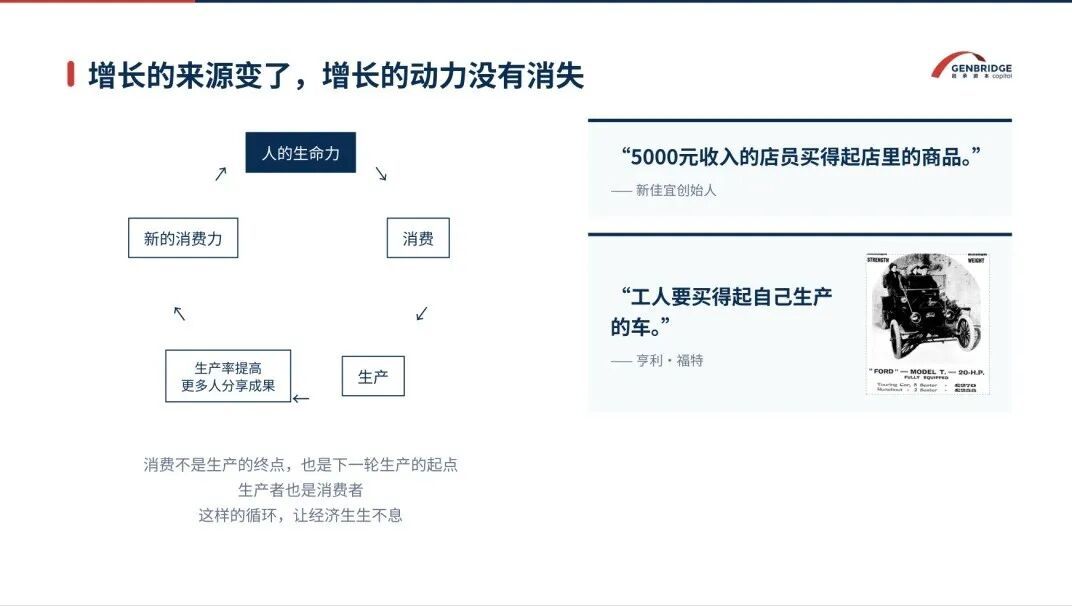
In China, there are still tremendous opportunities in the consumer industry. Only when consumers can afford the products they help create can this cycle continue to move forward. There is still much work to be done and significant value to be created to achieve this goal.。
Only in this way can our economy continue to thrive and renew itself. I believe this is also the most important reason why we are passionate about consumption and continue to explore this field.
Finally, I would like to close with the words “生生不息” — an endless cycle of growth and renewal. I hope everyone’s investments can also continue to grow and thrive. Thank you.