

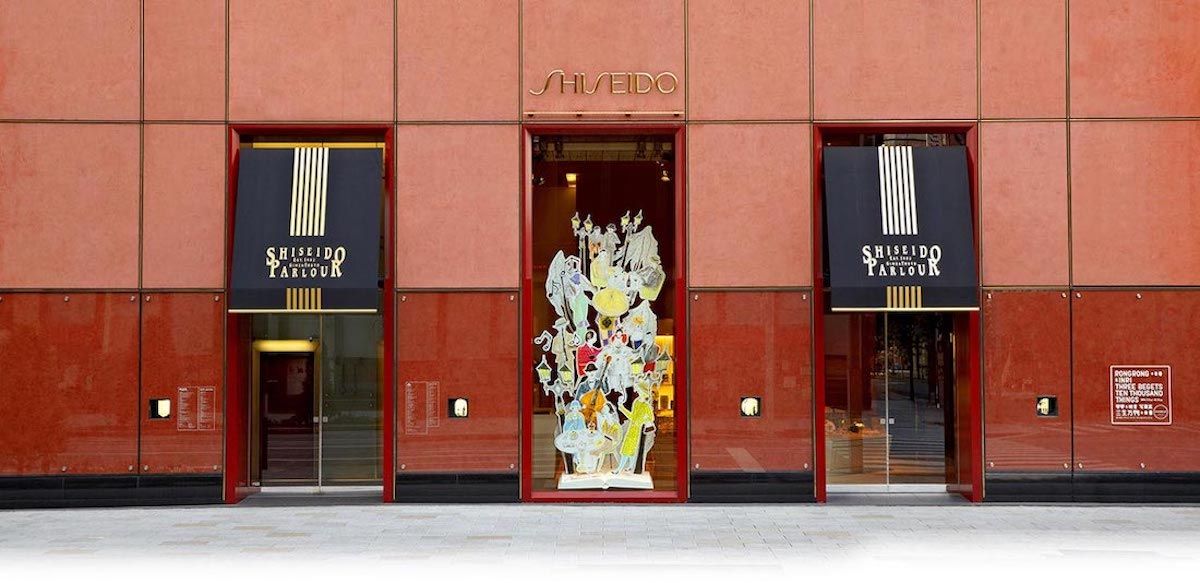
What you are about to read is an exclusive, in-depth study of Shiseido.
In a cosmetics industry long dominated by Europe and the U.S., Shiseido, born in Asia, has stood shoulder to shoulder with global giants. It has defined beauty and style for generations and earned worldwide acclaim. Yet after its peak came a steady decline—despite multiple transformation attempts in recent years, it remains constrained and struggling.
As Chinese companies enter an era of scale, diversification, and globalization, echoes from history offer valuable lessons.
Over the next three weeks, we will present three in-depth articles, examining Shiseido’s century-long journey from the perspectives of brand culture and business model.
Author | Tojiro Kataya
Editor | Roy Zhang
Over the past 20 years, Chinese companies have made remarkable progress in products and sales. World-class manufacturing and efficient online channels have fueled the rise of domestic brands.
Today, consumers are essentially buying identity. Beyond functional value, products serve as carriers of meaning. This raises the bar—only brands that imbue meaning can endure and thrive.
Chinese companies have reached a point where building brand culture is no longer optional.
This is especially true in cosmetics. The industry is characterized by high gross margins, high selling expenses, and relatively low net margins. Consumers are willing to pay, yet barriers to manufacturing are low—forcing brands to bear high persuasion costs. In essence, cosmetics do not sell efficacy alone, but an idealized self-image. Brand culture is the most effective tool of persuasion.
Yet brand culture is difficult to articulate. It is inherently ambiguous—encompassing marketing narratives, organizational culture, and broader social trends. It is also often misunderstood as a tool for justifying premium pricing, leading many new brands astray.
To avoid confusion, we define “brand culture” here as a coherent system of products, symbols, and corporate behaviors built around a core value—consistent both internally and externally.
So how is brand culture built? Is there a textbook case worth studying?
The answer is Shiseido. Despite recent business challenges, its achievements in brand culture remain one of the most compelling case studies in the global cosmetics industry.
It established Asia’s first modern brand marketing team and created iconic campaigns. It reshaped how generations approached beauty, popularizing Japanese aesthetics across Asia. For over a century, Shiseido has been more than a cosmetics brand—it has defined beauty and led a premium lifestyle.
This is the inaugural article in our Shiseido case study series. We focus on brand culture, tracing its early history to understand how it built a premium brand representing the ideal feminine image.
Outline below:
01 Architecting aesthetic competency
02 Pioneering the lifestyle paradigm
03 Symbiosing brand essence with the era
04 Converting heritage into strategic capital
05 Epilogue: The zenith and the paradox
Architecting aesthetic competency
Many companies equate brand culture with visually appealing design. In reality, what matters more is an organizational capability that continuously produces aesthetic judgment, along with a distinctive narrative conveyed through a unified aesthetic system.
Shiseido solved this problem more than a century ago.
Let’s go back to 1872. Japan at the time was a society of cultural overlap. Ordinary people still used traditional cosmetics—white lead powder and blackened teeth—while in Tokyo’s Ginza district, Western-style streets were emerging, and elites had begun adopting European lifestyles, from fashion to wine.
That same year, Japan’s first Western-style pharmacy was established in Ginza. Its founder, Arinobu Fukuhara, a former chief pharmacist of the Japanese Navy, named it “Shiseido,” inspired by the phrase “All things are born from the earth至哉坤元,万物资生.” From the outset, Shiseido carried the modern, avant-garde spirit of Ginza.
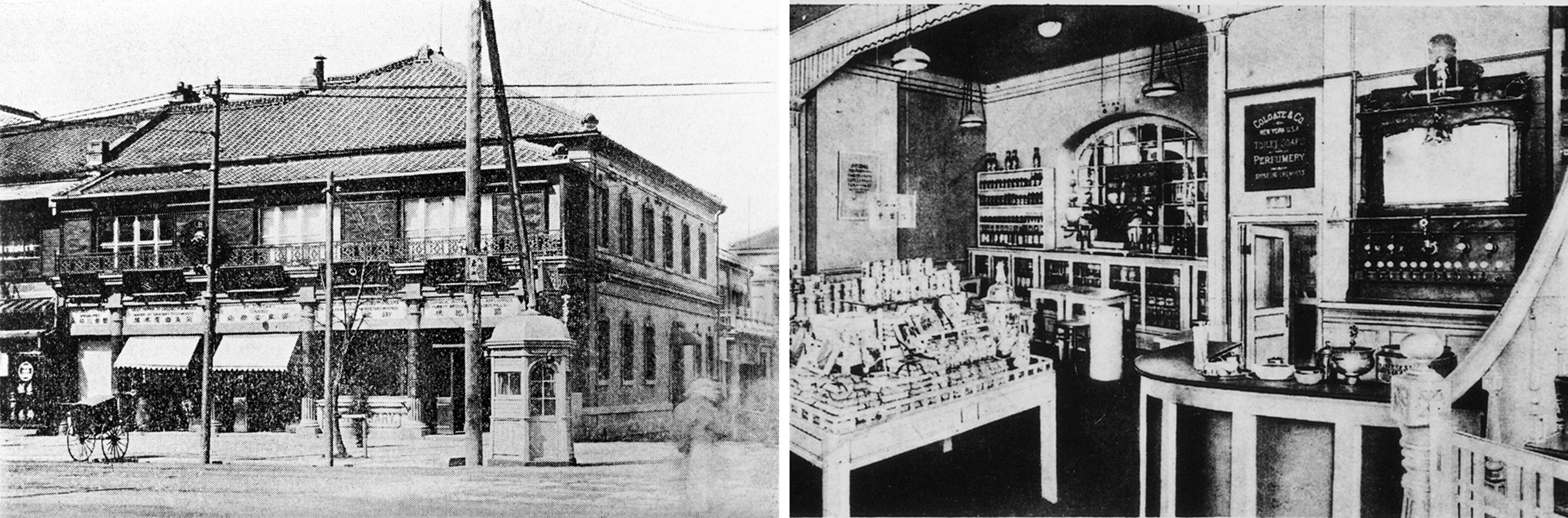
Left: Shiseido Pharmacy in Ginza; Right: A stylish soda fountain inside the pharmacy
However, it was not the founder but his son, Shinzo Fukuhara, who established Shiseido’s true legacy.
Graduted from Columbia University, Shinzo Fukuhara worked and traveled across Europe and the U.S., deeply influenced by Art Nouveau and Art Deco. These experiences gave him an aesthetic awareness and modern business mindset far ahead of his peers in Japan.
After taking over, he spun off the cosmetics division, giving birth to Shiseido as a beauty brand. He then made a rare decision for that era—forming an in-house design team(Ishō-bu), of top artists and designers to manage all brand expressions. This became Asia’s first modern brand marketing team.
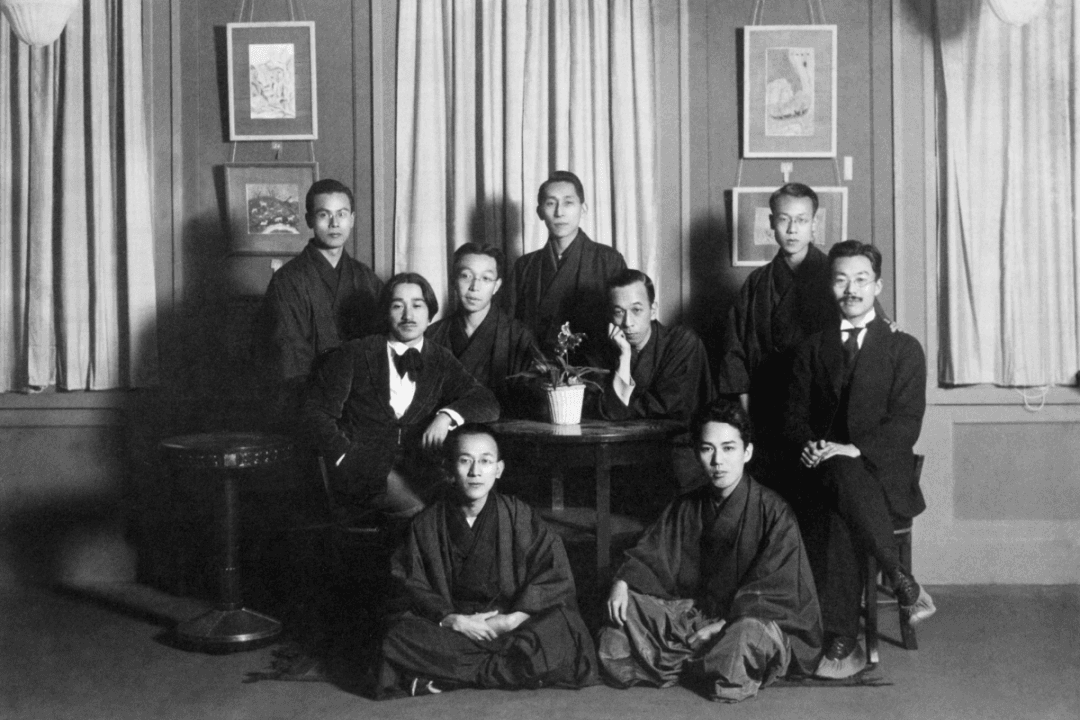
This was 1916. Most companies were still relying on street calls and newspaper ads. L’Oréal was selling hair dye, and Estée Lauder had yet to be founded. Modern advertising and corporate identity theory would not become widespread for another half century—highlighting Shiseido’s foresight.
The Ishō-bu unified all external touchpoints—packaging, print ads, brochures, storefront displays, and interiors. They also created the Hanatsubaki camellia logo, one of Asia’s most enduring and recognizable symbols. Even Shiseido’s proprietary typeface was developed during this period—a remarkable asset in the pre-digital era.
The team included talents like Ayao Yamana, later recognized in global design history. Their works were published in the in-house magazine, later renamed 《Hanatsubaki》, which became a condensed history of modern Japanese graphic design.
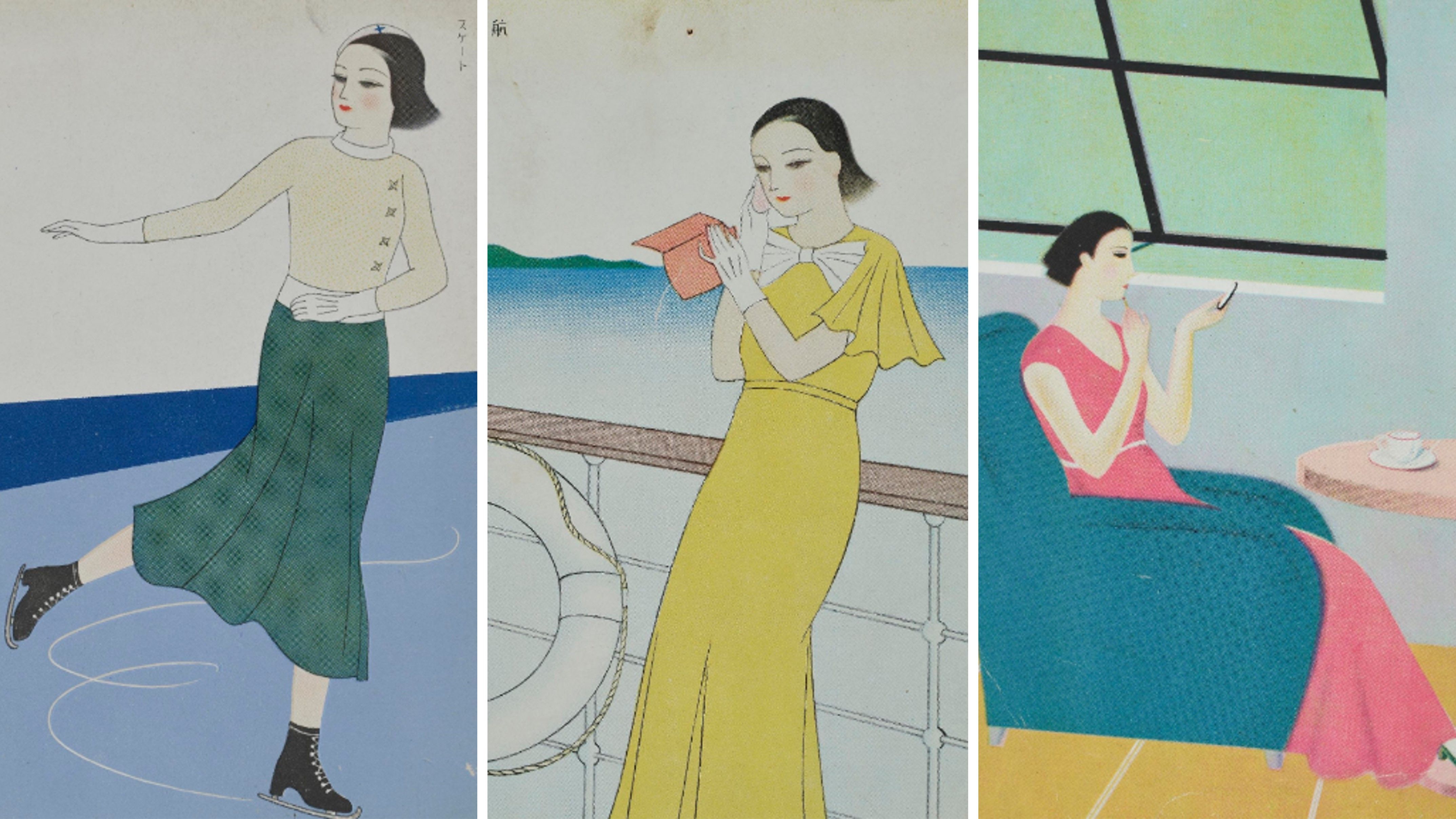
Postcards issued by Shiseido in 1932 captured the fashionable lifestyles of women of that era
Viewed through a contemporary lens, these works remain remarkably evocative, continuing to inspire scholars and cultural critics alike. American scholar Gennifer Weisenfeld, for instance, argues that the elongated, graceful female figures in Shiseido’s advertising are neither explicitly Western nor Japanese. Instead, they embody a de-racialized “world citizen” ideal, suggesting that through Shiseido’s products, consumers could access a form of self-fashioning unbound by nationality or historical time. For Japanese women navigating the tensions between East and West, and between tradition and modernity, such imagery proved especially compelling.
These posters portrayed dreamlike luxury, while product descriptions emphasized science, hygiene, and efficacy. Shiseido thus combined romantic imagination with modern beauty science—a “fantasy + science” narrative that remains central to premium beauty brands today.
Through its pursuit of aesthetics, Shiseido conveyed emotional value beyond function—buying its products meant seeking nourishment for beauty and vitality.
This value aligns perfectly with the essence of Shiseido’s name — “All things beautiful come from nature.” Ever since, all of Shiseido’s slogans, such as “Beauty in Every Moment of Life” and “Beauty Innovations for a Better World,” have remained rooted in this core philosophy.
What Shinzo Fukuhara left to Shiseido was not a single hit product, but an organizational capability to continuously create beauty around a coherent brand narrative. It may not appear on the income statement, yet it quietly shapes consumer trust and imagination toward the brand.
Pioneering the lifestyle paradigm
“Lifestyle” is a broad and layered concept, and “lifestyle brands” have become equally diluted. In the market, it often seems that having more categories, higher prices, and better design is enough to qualify. But whether the positioning is accurate, or whether the lifestyle proposed is truly leading, is often questionable.
So how does one build a true lifestyle brand? Shiseido offers a textbook example.
In the 1920s, the aftermath of war brought mass consumer industries, independent women entering the workforce, and a culture of instant gratification—marking the first true global cultural movement. New York had flappers, Paris had garçonnes, Shanghai had modern girls, and Tokyo had “Moga” (Modern Girls).
According to research by Japanese anthropologist Kon Wajirō, women in modern attire accounted for merely 1% of the total population across Tokyo. Yet in districts such as Ginza and Nihonbashi, this figure rose sharply to 25%. It was in Ginza that these “modern girls” congregated—and it was precisely there that Shiseido positioned its store, at the very center of this cultural transformation.
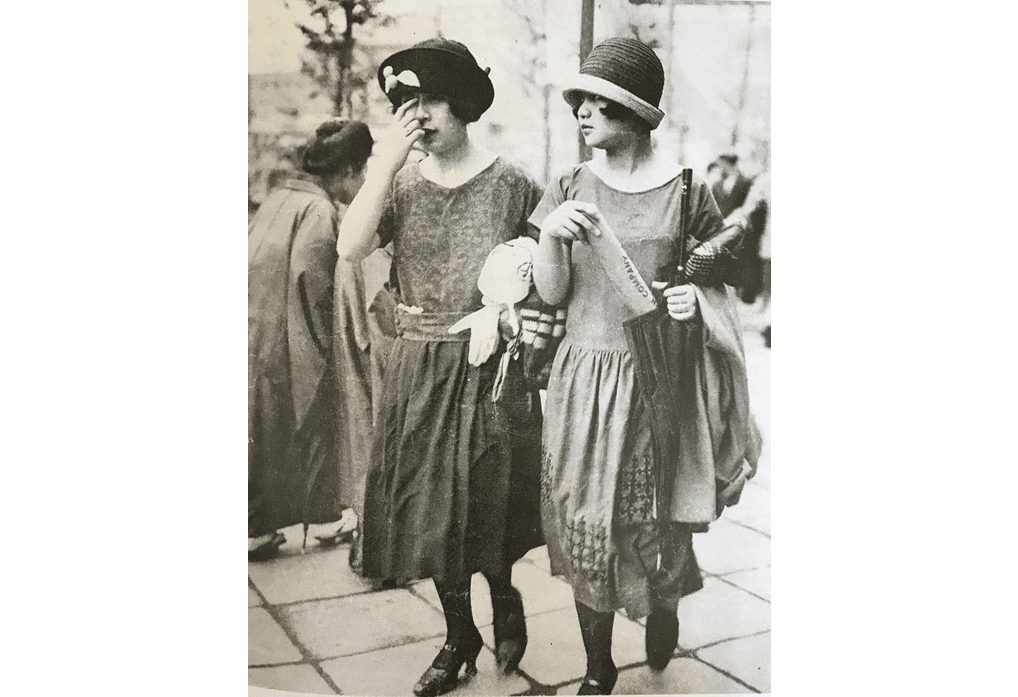
At this turning point of lifestyle transformation, Shiseido, having established its aesthetic system, seized the opportunity with two key actions:
First: defining lifestyle.
If the “Modern Girl” movement was a global cultural hurricane sweeping across continents, then 《Hanatsubaki》, the magazine published by Shiseido, functioned as the architect that channeled this force into the everyday fabric of Japanese society. Its predecessor was the internal corporate bulletin Shiseido Monthly Journal , but with the establishment of the Hanatsubaki Club membership system, the publication evolved into a hybrid cultural medium—part fashion magazine, part literary journal, and part lifestyle guide.
Within its pages, Western film icons’ makeup styles were meticulously deconstructed, alongside European dining etiquette and the art of coordinating Western dress with accessories. It offered step-by-step guidance on scientific skincare routines, the application of different textures of creams, and even eyebrow shaping techniques based on facial bone structure. Beyond beauty and lifestyle instruction, 《Hanatsubaki》 also published extensive essays on literature, philosophy, and the arts, significantly expanding the intellectual and aesthetic horizons of its readership, and constructing an aspirational world of elegance, modernity, and artistic sensibility.
At its core, what 《Hanatsubaki》 accomplished was the translation of an abstract lifestyle ideology into tangible, reproducible daily practices. In doing so, it sought to codify a new set of social norms—effectively defining what “beauty” and a “beautiful life” meant for a new era.
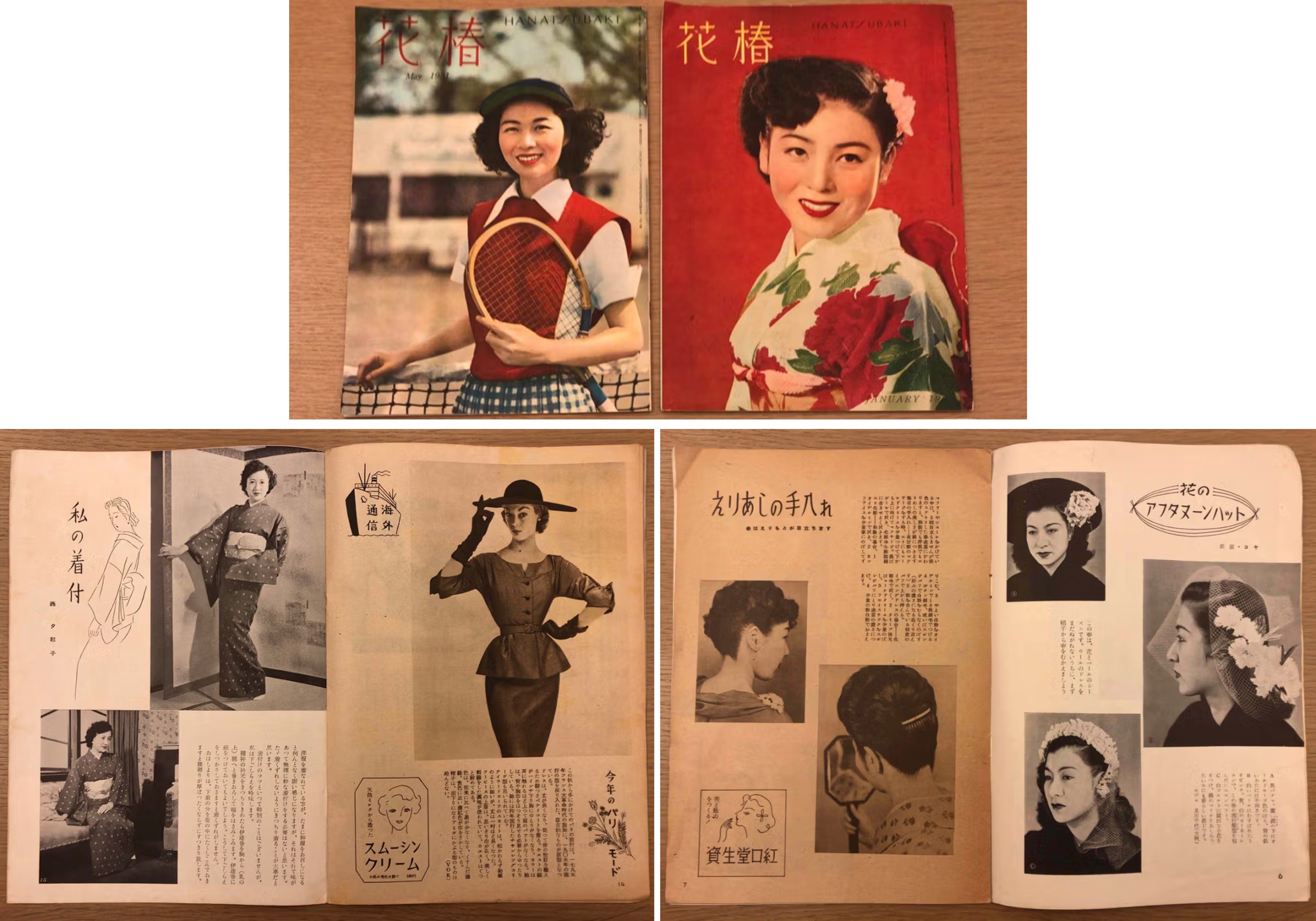
Cover and inner pages of Hanatsubaki magazine, 1951
Second: creating a stage for lifestyle expression.
Shinzo Fukuhara opened two venues in Ginza: one was a cosmetics store that also functioned as a gallery and R&D space; the other was the Western-style restaurant Shiseido Parlour.
The restaurant catered to affluent women and social elites, offering the most fashionable services of the time. To cultivate an aspirational atmosphere, it recruited handsome young male waiters from across Japan and imported soda fountains and ice cream machines from the United States (notably, Shiseido had been the first pharmacy in Japan to introduce a soda counter, consistently staying ahead of trends).
The restaurant effectively became an informal club for modern girls. Shiseido was not merely operating a physical space, but cultivating a core user community. Within this curated setting, influential women conversed over food and drink, wearing makeup featured in Hanatsubaki and using tableware and linens designed by the in-house design team—becoming, in themselves, part of the Shiseido brand image.
In doing so, Shiseido transformed its advocated lifestyle into a tangible, experiential, and consumable physical environment.
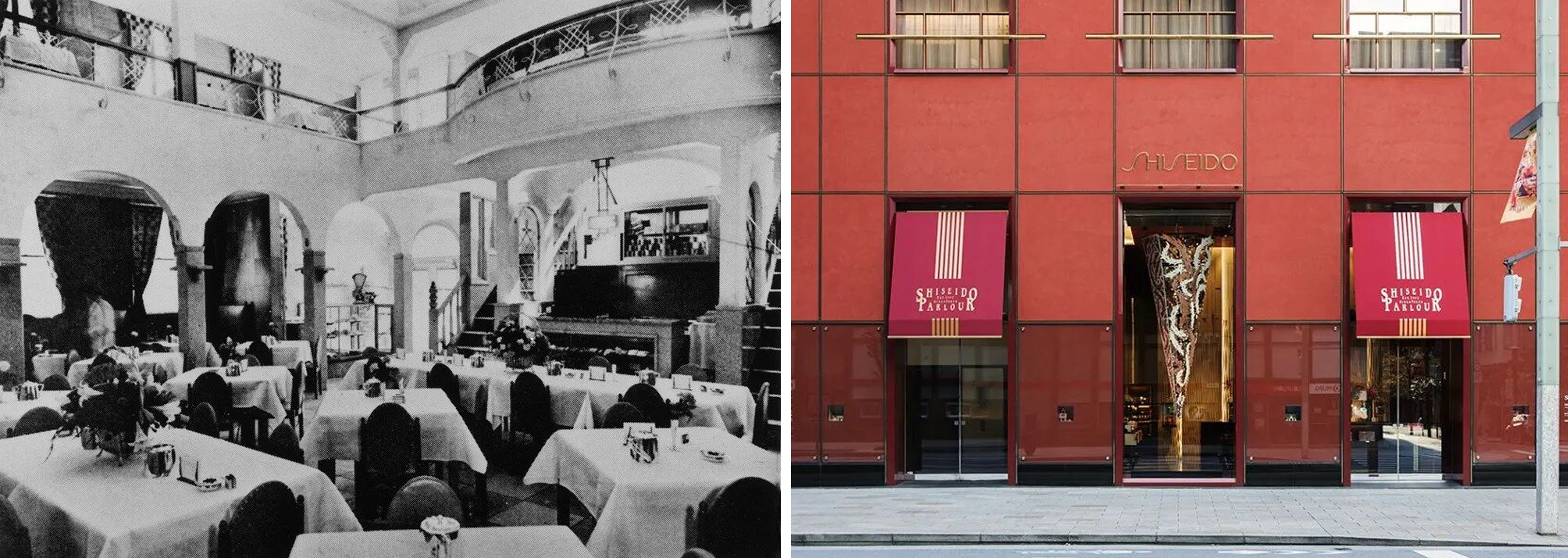
Left: Shiseido Western-style restaurant in 1934. Right: Shiseido Western-style restaurant today
It is worth noting that Shiseido’s early cosmetics business was not particularly profitable. Although the brand enjoyed nationwide recognition, product circulation was limited, and prices were two to three times higher than comparable offerings. To sustain this premium positioning, Shiseido relied on revenue from its restaurant business to subsidize losses in cosmetics.
However, Shinzo Fukuhara was in no rush to lower prices. If a brand functions as a passport to identity, then the “inflation” of that access must be carefully managed. Price, in this sense, is an integral component of brand power.
Today, Shiseido has evolved into a comprehensive group spanning entry-level to high-end skincare. Yet its premium segment marketing approach remains strikingly consistent with a century ago. In 2002, it launched the sub-brand “THE GINZA,” positioned as haute couture skincare—cost-insensitive in R&D and deliberately limited in production, with a single cream priced as high as 8,000 yen, more than double its top-tier brand Clé de Peau Beauté (CPB).
In summary, Shiseido’s success lies in its ability, amid the Westernization of society, to offer a complete lifestyle proposition centered on a new generation of modern women—selling not only cosmetics, but also aesthetics, social identity, and belonging. This opportunity was deeply rooted in Ginza’s unique cultural context, and to this day, the Shiseido logo still carries the words “Ginza Tokyo,” treating a single district as the spiritual origin of the brand.
Symbiosing brand essence with the era
If brand culture remains only a founder’s legacy, it risks becoming a museum artifact. Truly vital brand culture must evolve with the times while preserving its core.
Shiseido’s concept of “Successful Aging” exemplifies this.
After entering the 1980s, Japanese society underwent another profound transformation, with the elderly population reaching 9% and the trend of aging becoming irreversible. In the industry’s conventional narrative around “aging,” the dominant framing was “anti-aging,” treating aging as an adversary. Shiseido, however, proposed a different stance: rather than resisting aging, one should reconcile with it, and live each stage of life with beauty and dignity.
At its core, this perspective is a reinterpretation of the brand’s founding ethos, “all things beautiful come from nature”, in the context of an aging society, despite shifts in time and age, the pursuit of beauty and vitality remains constant.
To substantiate this view, Shiseido even drew on neuroscience research, suggesting that the act of makeup application activates the parasympathetic nervous system and enhances a sense of well-being. In this framing, cosmetics were elevated from “beauty tools” to an “effort toward happiness.”
“Successful Aging” was not merely a marketing slogan, but a comprehensive system combining initiatives, product design, and social advocacy.
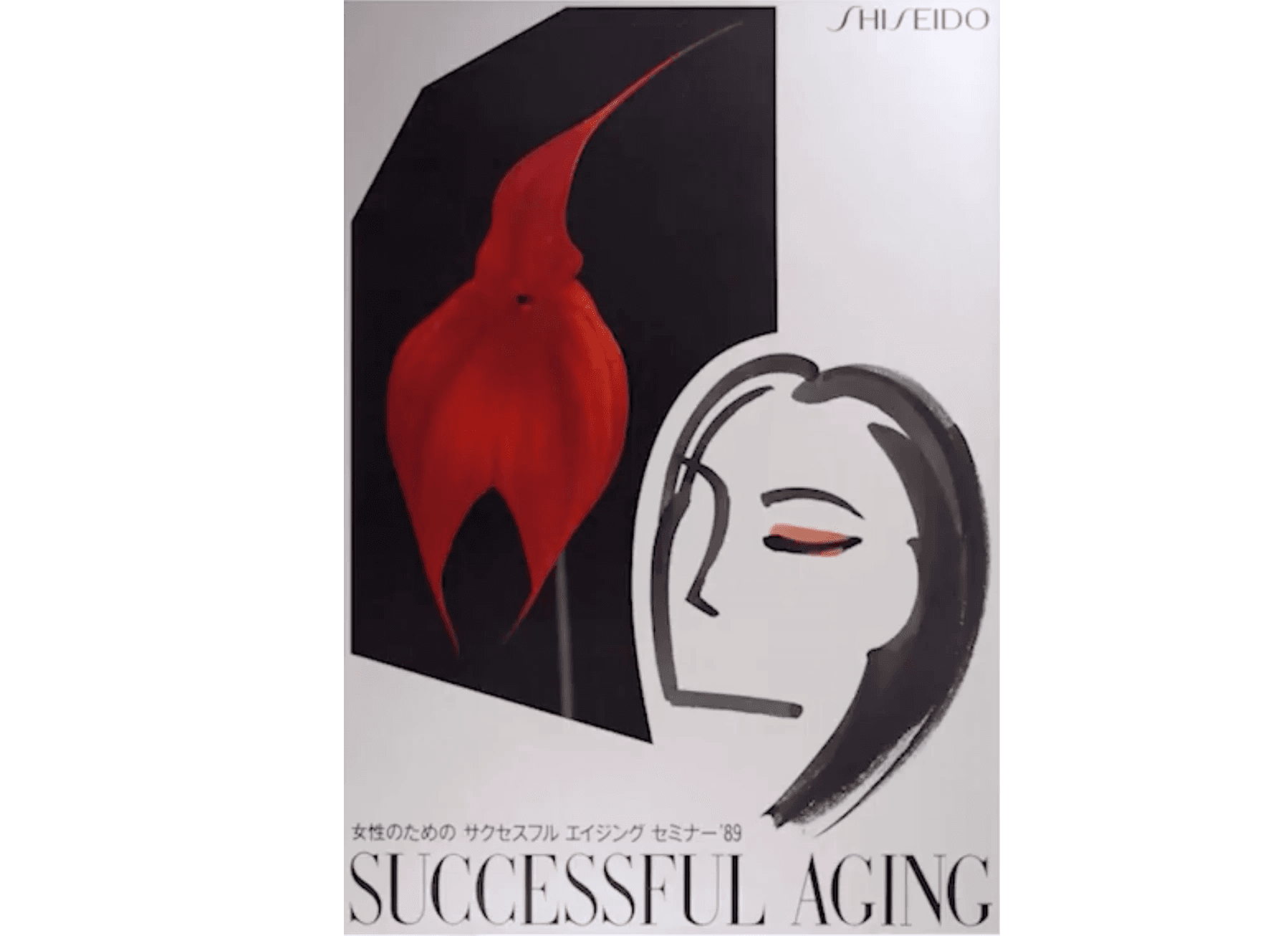
Poster of the first Successful Aging Forum
From the late 1980s onward, Shiseido began hosting the “Successful Aging Forum” every two years, inviting experts from medicine, psychology, and sociology to present the latest research on how to “age beautifully.”
Its BA (Beauty Advisor) teams, leveraging their role at the front line of customer touchpoints, also extended into local communities. They conducted grooming and makeup workshops in elderly care facilities and institutions for people with disabilities, offering beauty techniques and lifestyle guidance to middle-aged and older women, helping rebuild self-esteem and social engagement.
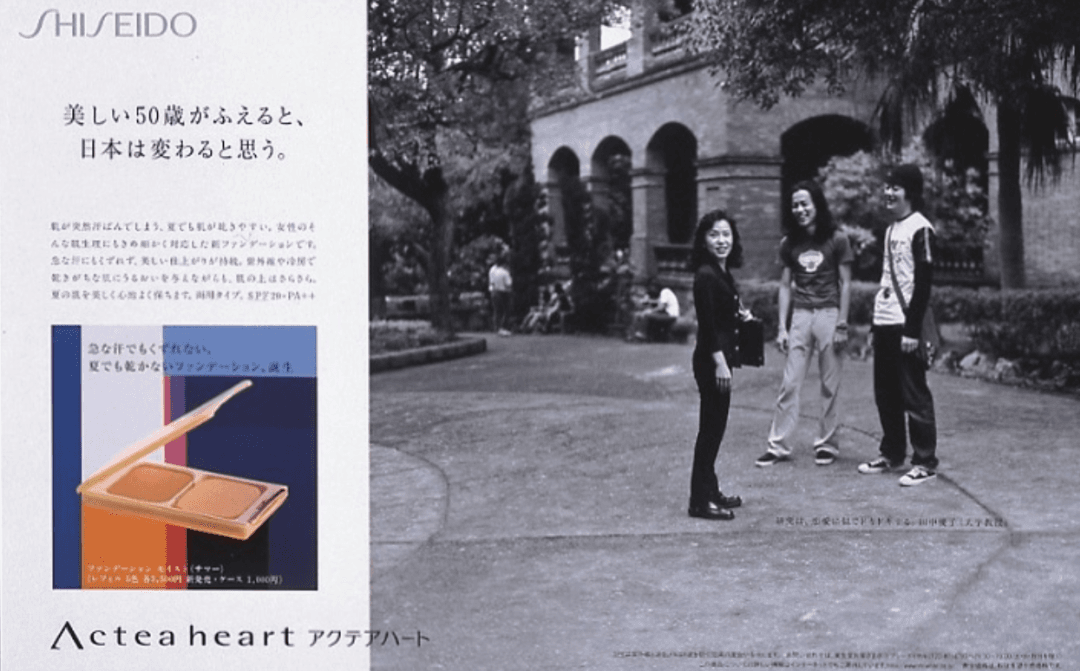
In 1998, a landmark advertising line emerged: “美しい50歳がふえると、日本は変わると思う,” meaning “If the number of beautiful 50-year-olds increases, I believe Japan will change.” This campaign came from Actea Heart, a Shiseido brand targeting women aged 50 and above.
In the campaign, Shiseido did not use “ageless celebrities” as ambassadors. Instead, it featured women with authentic social identities—such as university professors and individuals returning to education—depicting their real lives and work. This stands as a near-pure embodiment of the “Successful Aging” philosophy.
It is not difficult to see that, in the context of an aging society, Shiseido’s actions remained consistent with its approach decades earlier:
(1) At moments of structural societal change, it sensitively captures emerging social sentiment;
(2) It defines new lifestyles and constructs idealized visions of living and self-identity;
(3) It translates aspirations for the ideal into concrete actions that can be realized through consumption of Shiseido products.
Converting heritage into strategic capital
After the 1970s oil crisis, “efficiency,” epitomized by the Toyota Production System, became the key formula for Japanese corporate success. However, as markets matured, the marginal returns of relentless efficiency and cost competition began to decline. By the 1990s, a new wave emerged in Japanese business circles: companies began upgrading their logos and brand philosophies, increasingly treating brand culture as a core pillar for sustaining corporate longevity.
From its earliest days, Shiseido had already invested heavily in brand culture, far ahead of its peers. In this new era, its mission evolved from “doing things well” to “thinking things through,” distilling accumulated cultural practices into theory to guide the future.
To this end, on its 120th anniversary in 1992, then tenth-generation CEO Yoshiharu Fukuhara (grandson of the founder) established a Corporate Culture Department and a Corporate Archive Museum, and published 《What it has created and what it transmits 創ってきたもの、伝えてゆくもの》, elevating corporate culture to the level of management theory. One of its key ideas was “cultural capital management,” namely:
Culture is not a consumable or decorative asset; it functions like capital and is capable of generating value. A company’s cultural assets act like an internal platform: cultural accumulation from one era becomes the incubator for creativity and brand storytelling in the next.
If brand culture is an asset, how can it be monetized? Shiseido answered this question through one case.
In 1980, Shiseido officially entered the French market, aiming to secure a place in Paris, the global fashion capital. However, French consumers at the time were skeptical of Japanese brands, viewing Shiseido as merely a “product-selling company,” lacking the cultural depth and brand narrative they highly valued. As a result, its performance remained modest.
To break this stereotype, Shiseido appointed Serge Lutens (former Creative Director at Dior and founder of the eponymous brand) as Image Director, carefully shaping its brand presence in Europe.
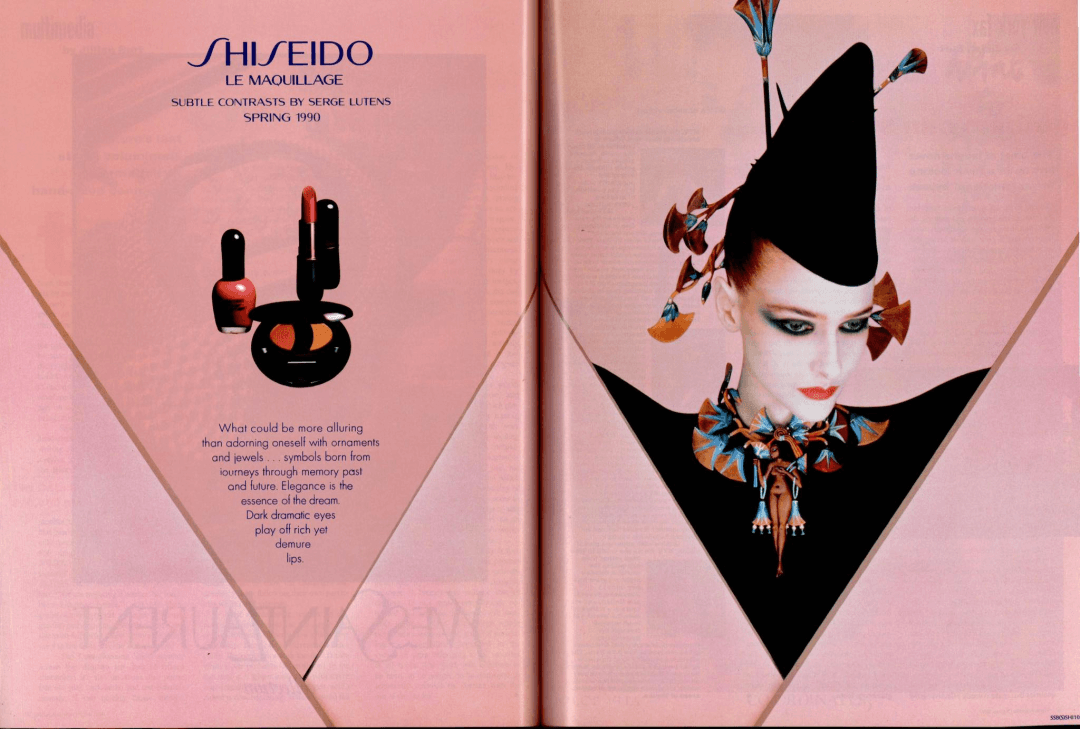
1990 Vogue editorial for Shiseido makeup shot by Lutens
In 1986, Shiseido decided to showcase its 114-year aesthetic legacy in one of Paris’s most prestigious cultural venues. At the Musée des Arts Décoratifs near the Louvre, it launched the exhibition “Shiseido, Art and Science of Beauty: 1872–1986,” displaying around 160 works including posters, magazine ads, products, and TV commercials since its founding. The exhibition attracted over 12,000 visitors in three months and received widespread acclaim.
Through this exhibition, Shiseido demonstrated that it possessed an independently evolving aesthetic system blending Eastern and Western sensibilities, rather than being merely an Asian manufacturer reliant on modern technology, thereby reshaping French perceptions of the brand.
The exhibition’s acclaim quickly translated into business opportunities. In the same year, Shiseido acquired the prestigious French hair salon Carita, established multiple local factories, and in 1992 launched the highly successful “Issey Miyake L’Eau d’Issey,” further driving its success in Germany, Spain, and the UK.
From a traditional marketing perspective, these “past advertising artifacts” had lost their promotional function. Yet as cultural assets, they generated value that went far beyond people, goods, and capital.
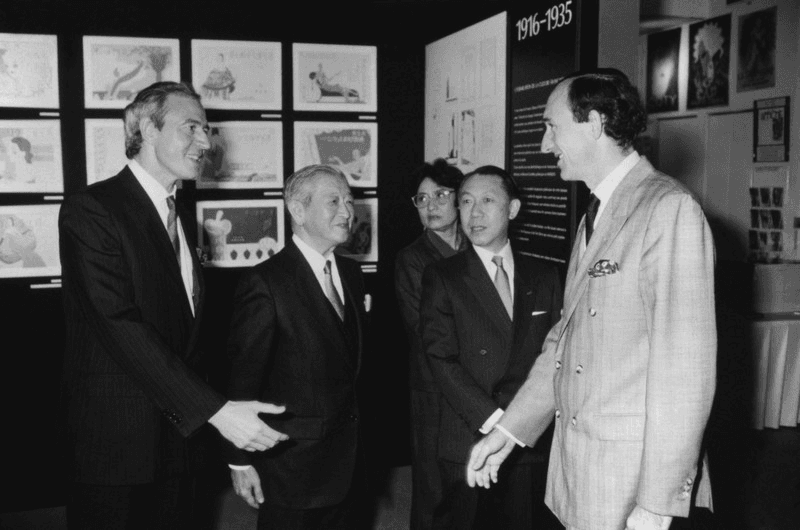
Opening reception of the 1986 Shiseido advertising exhibition
From the Camellia logo to the Modern Girl, from Ginza cafés to Paris exhibitions, every shift in consumer demand for beauty allowed Shiseido to generate new responses from its accumulated cultural assets. This is the compounding effect of “cultural capital,” as described by Yoshiharu Fukuhara.
To this day, practices pioneered by Shiseido—refined design, brand magazines, and curated exhibitions—have become industry standards. Yet many focus only on the form, overlooking the meaning behind it. Shiseido’s true leadership in brand culture lies in this: every brand action is anchored in its core ethos—beauty and vitality.
Epilogue: The zenith and the paradox
At the turn of the 21st century, following the collapse of Japan’s asset bubble economy, the once exuberant Westernized lifestyle became increasingly unsustainable. Urban white-collar consumers began to seek spiritual comfort in native traditions. In the commercial sphere, this gave rise to “Wa-Modern,” a movement blending contemporary aesthetics with Japanese sensibilities—Japan’s equivalent of a “domestic revival” in consumer culture.
Shiseido seized this emerging cultural tide and boldly leveraged its iconic brand symbol, the camellia “Hanatsubaki,” launching the TSUBAKI haircare line. Developed with skincare-level R&D logic applied to haircare products, it was priced 30%–40% above conventional mass-market offerings.
To challenge the dominance of Procter & Gamble and Unilever, Shiseido invested approximately 5 billion yen in a massive marketing campaign, featuring nearly all of Japan’s top actresses. It delivered a collective statement of cultural confidence: “Japanese women are beautiful.” Fueled by powerful emotional resonance, TSUBAKI generated 4 billion yen in sales within its first month, immediately securing the top position in market share.
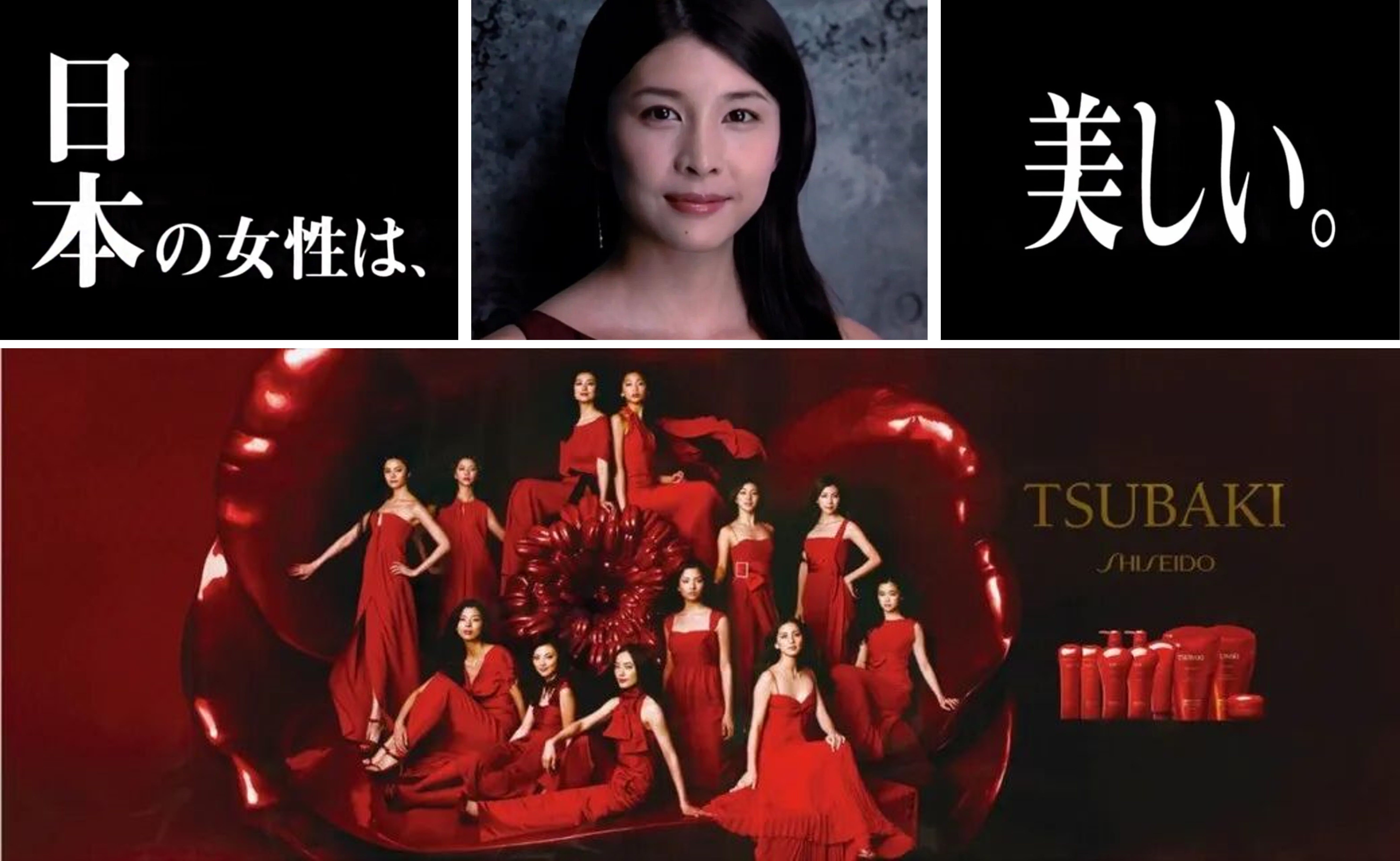
The success of TSUBAKI marked another triumph of Shiseido’s brand culture strategy. The following year, net sales reached 720 billion yen, the highest level in the company’s history since its founding. Buoyed by this expansion, Shiseido articulated an ambitious ten-year vision: “Rooted in Japan, becoming a global company representing Asia.” This was a declaration of globalization strategy—aiming to define and export Asian aesthetics while competing directly with L’Oréal and Estée Lauder on the global stage.
However, this time Shiseido was unable to replicate its past success formula. TSUBAKI’s brilliance proved fleeting and soon fell into losses. In 2008, net sales dropped by 30 billion yen, ushering in years of negative growth, while operating margins remained persistently low, hovering between 3% and 7%.
How did a century-old brand with such strong momentum and deep national recognition—an empire that once defined beauty for generations—suddenly come to a standstill?
Beyond the brand’s cultural ethos, our next analysis will deconstruct its business model to uncover the inflection points where Shiseido’s peak momentum turned into its current predicament.
References
1. Gennifer Weisenfeld. "Shiseido Chic: The Cosmopolitan Aesthetics of Japanese Cosmetics." In Wearing Modernity: Changing Fashions, Body, and Culture in Japan and its Diaspora. Ithaca: Cornell University Press
2. Yoshiharu Fukuhara. 《My Multi-Track Life. ぼくの複線人生》. Iwanami Shoten, 2007.
3. Yoshiharu Fukuhara.《Cultural Capital Research Group. Management of Cultural Capital: What Corporations and Executives Must Consider in the Future. 文化資本の経営——これからの時代、企業と経営者が考えなければならないこと》 Diamond, Inc., 1999.
4. Shiseido Corporate Division. 《What It Has Created, What It Transmits. 創ってきたもの 伝えゆくもの》, 1992.